Human digestive system
Sample content · for subject-expert review
These original reference notes and AI-generated illustrations are examples for discussion, not a curriculum-approved lesson. You eat a piece of chapati. How do its nutrients become available to the rest of your body?
Learning objectives
Trace food through the digestive tract, explain how digestion breaks food down, and identify where most digested nutrients are absorbed.
From mouth to stomach
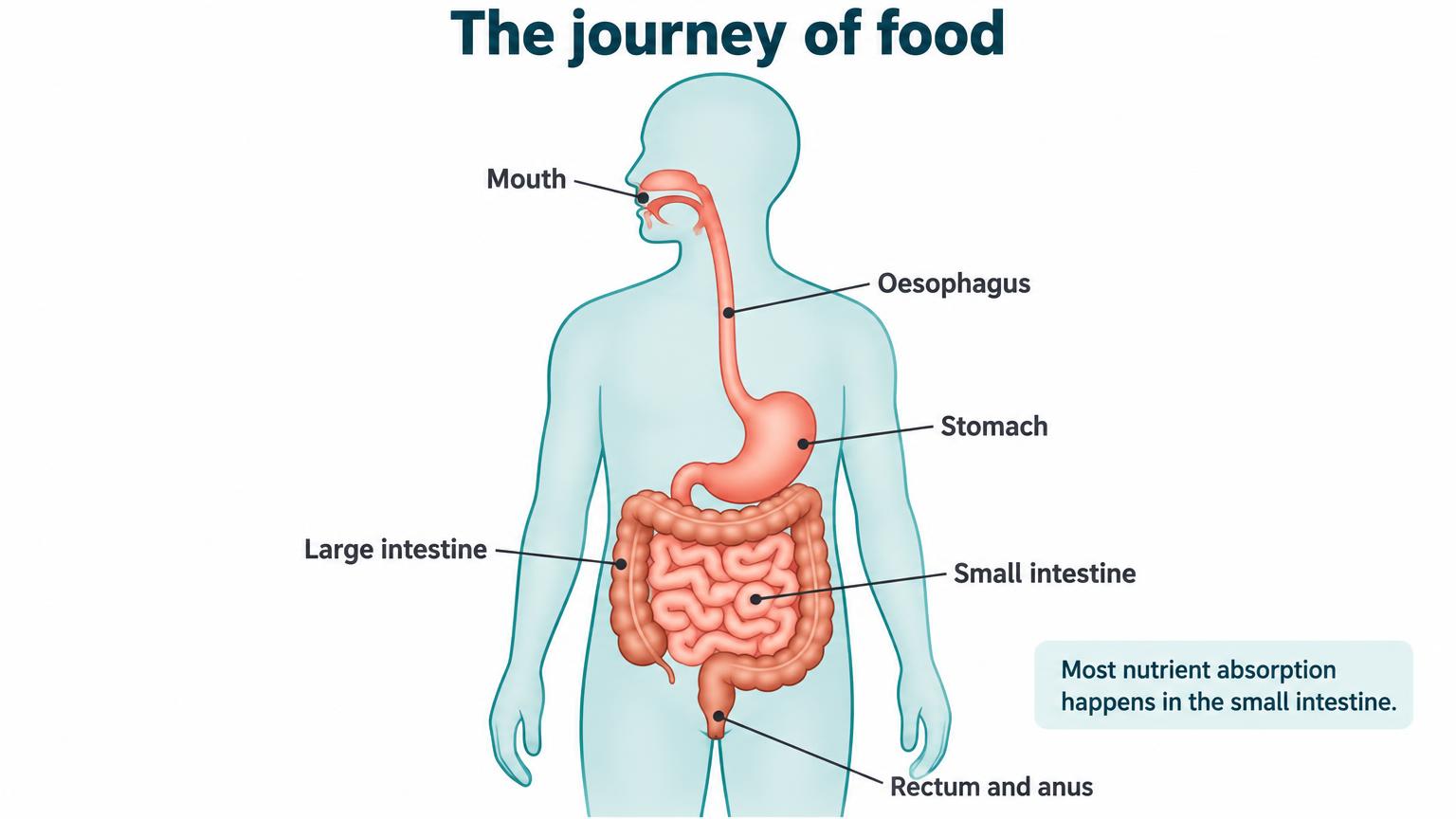
Digestion begins in the mouth. Teeth break food into smaller pieces, saliva moistens it, and a salivary enzyme begins breaking down starch. Swallowed food passes through the oesophagus to the stomach. Muscular contractions move it along; it does not simply fall by gravity. The stomach churns food and mixes it with acid and digestive enzymes.
Digestion and absorption
Digestion breaks large food molecules into smaller molecules. In the small intestine, digestion continues with help from digestive juices, including enzymes from the pancreas. Bile, made by the liver and stored in the gallbladder, helps break fat into small droplets; bile is not an enzyme. Most digested nutrients are absorbed through the wall of the small intestine. Finger-like villi provide a large surface area for absorption.
What happens to the remainder?
The large intestine absorbs water and salts from the remaining material. Undigested material forms faeces, which are stored in the rectum and leave through the anus. Passing undigested food out is different from removing wastes produced inside body cells.
The route food follows
| Organ | Main role |
|---|---|
| Mouth | Chewing; saliva begins starch digestion |
| Oesophagus | Moves swallowed food to the stomach |
| Stomach | Churns food; acid and enzymes help digestion |
| Small intestine | Completes much digestion; absorbs most nutrients |
| Large intestine | Absorbs remaining water and salts |
| Rectum and anus | Store and release faeces |
Worked example · a bite of chapati
- 1Chewing makes smaller pieces and mixes them with saliva.
- 2Salivary enzymes begin digesting starch; food travels through the oesophagus.
- 3The stomach mixes food; digestion continues in the small intestine.
- 4Starch is eventually broken into small sugar molecules, which can be absorbed.
- 5Undigested material continues to the large intestine before leaving the body.
Check your understanding · suggested answers
- 1Where does digestion begin? Answer: the mouth.
- 2Where are most digested nutrients absorbed? Answer: the small intestine.
- 3How is digestion different from absorption? Answer: digestion breaks food down; absorption moves digested nutrients through the intestinal wall into the body.
Common misconception
The stomach absorbs most nutrients. Correction: most nutrient absorption happens in the small intestine. Food does not pass through the liver or pancreas; these organs supply substances that help digestion.
Activity · Sequence the journey
Write mouth, oesophagus, stomach, small intestine, large intestine, rectum and anus on seven paper cards. Arrange them in order. Place liver and pancreas beside the small intestine rather than in the food pathway, and explain their supporting roles.
Key takeaways
- Digestion begins in the mouth and continues along the digestive tract.
- Digestion and absorption are different processes.
- Most nutrient absorption happens in the small intestine.
- The large intestine absorbs remaining water; rectum and anus handle faeces.
- Sample content: curriculum alignment and expert approval are pending.