Parts of a flowering plant
Sample content · for subject-expert review
These original reference notes and AI-generated illustrations are examples for discussion, not a curriculum-approved lesson. Picture a bean plant in a garden: how do its different parts help it live and grow?
Learning objectives
Name the main parts of a flowering plant, describe what each part does, and use observations to connect plant structures with their functions.
Roots and stems
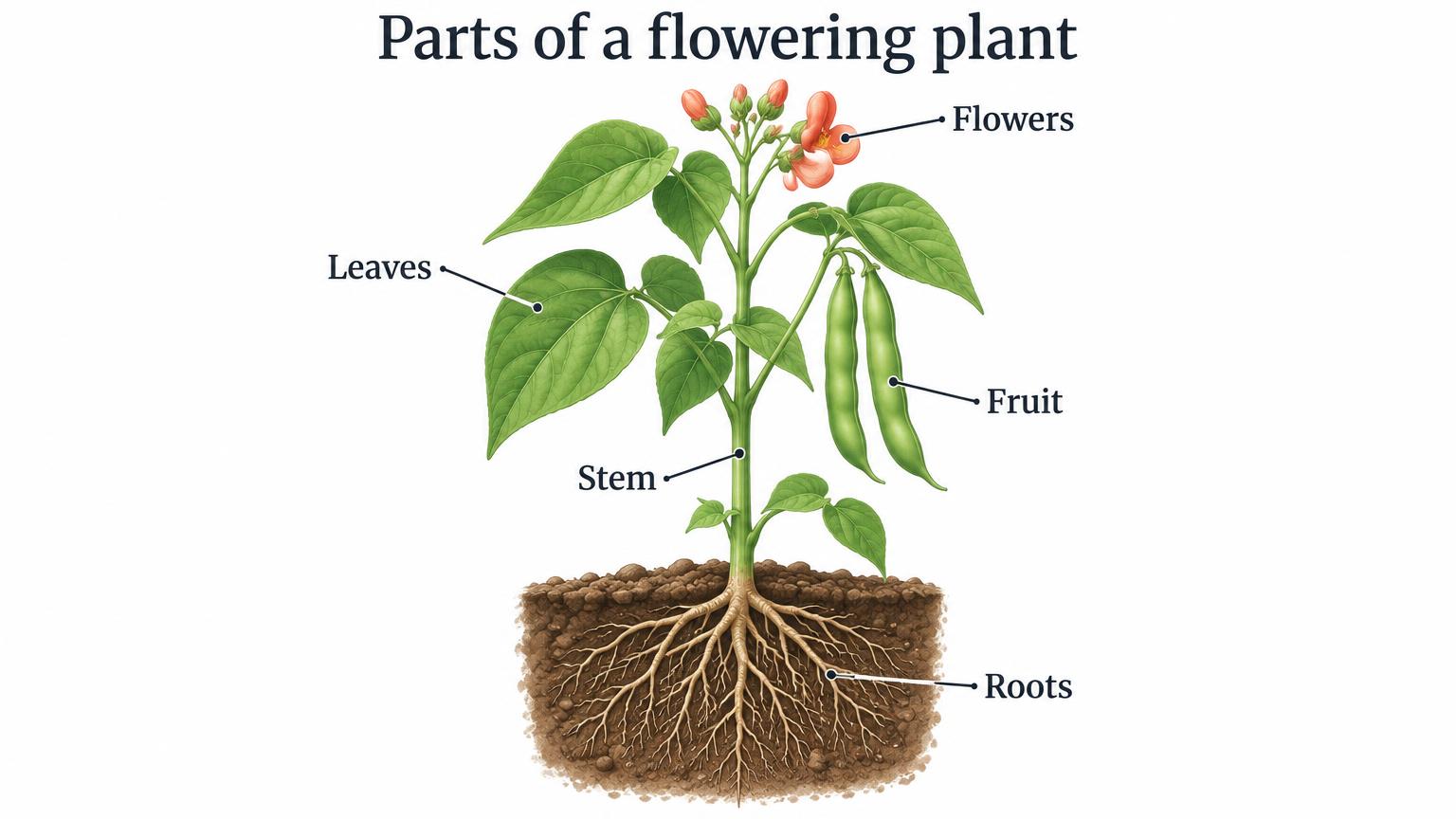
Roots usually anchor a plant and absorb water and dissolved minerals from soil. Some roots also store food. The stem supports leaves, flowers and fruits. It contains tissues that carry water and minerals from the roots, and sugars from leaves to other parts of the plant.
Leaves, flowers and fruits
Leaves are common sites of photosynthesis: they use light energy to make sugars. Flowers contain reproductive parts. After pollination and fertilisation, a flower's ovary can develop into a fruit, and its ovules can develop into seeds. A bean pod is a fruit even though we use it as a vegetable in cooking.
Plant parts and their jobs
| Part | Main function | Example |
|---|---|---|
| Roots | Anchor the plant; absorb water and minerals | Fine roots of a bean plant |
| Stem | Support the plant; transport materials | Upright bean stem |
| Leaves | Make sugars by photosynthesis | Green bean leaves |
| Flowers | Contain reproductive parts | Bean flowers |
| Fruit | Protect seeds; may help their dispersal | Bean pod with seeds inside |
Worked example · a wilting bean plant
- 1A bean plant has damaged roots and begins to wilt.
- 2Roots normally take up water; damage can reduce water uptake.
- 3Less water reaches the leaves through the stem.
- 4Check soil moisture and root condition. Wilting alone does not prove the roots are damaged; heat or dry soil can also cause it.
Check your understanding · suggested answers
- 1Which part usually absorbs water from soil? Answer: roots.
- 2Give two jobs of a stem. Answer: support and transport of materials.
- 3Why is a bean pod a fruit? Answer: it develops from the flower's ovary and contains seeds.
Common misconception
Plants get their food directly from soil. Correction: soil supplies water and minerals, but green plants make sugars through photosynthesis. Root shapes also vary; not all roots grow deeply.
Activity · Observe and label
Look at a safe garden plant or the illustration above. Without pulling up a living plant, draw and label its visible parts. Use the illustration for roots. Write one function next to each label; do not taste unknown plants.
Key takeaways
- Roots absorb water and minerals; stems support and transport.
- Leaves commonly make sugar using light energy.
- Flowers are involved in reproduction; fruits contain and protect seeds.
- Sample content: curriculum alignment and expert approval are pending.