Photosynthesis: how plants make food
Sample content · for subject-expert review
These original reference notes and AI-generated illustrations are examples for discussion, not a curriculum-approved lesson. A plant grows without being fed rice or bread. Where does its food come from?
Learning objectives
Explain photosynthesis simply, identify its raw materials and energy source, and distinguish plant food from water and minerals.
Making sugar using light
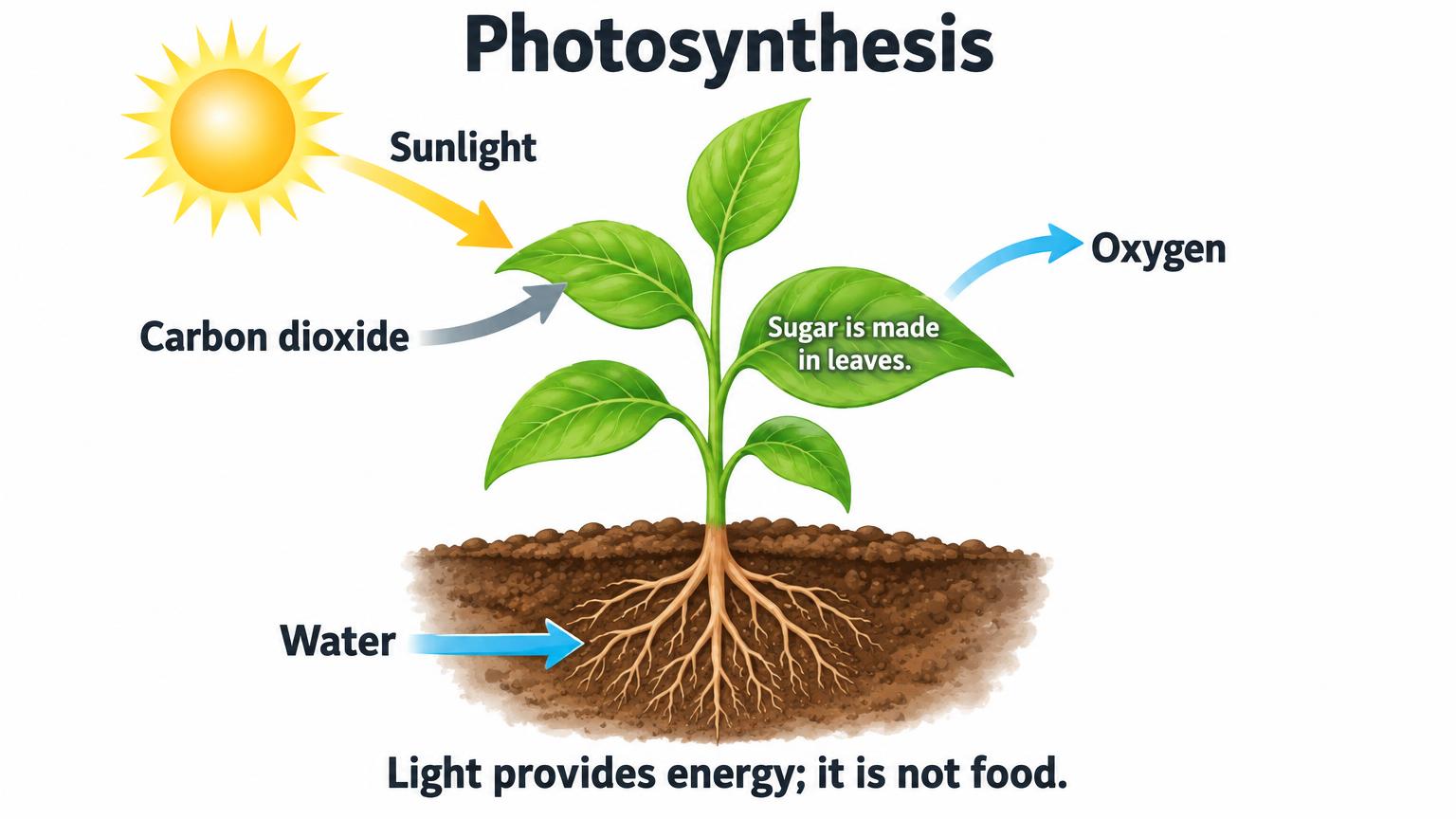
Photosynthesis is the process by which green plants use light energy to make sugars from carbon dioxide and water. It happens mainly in leaf cells containing chloroplasts. Chlorophyll, the green pigment in chloroplasts, absorbs light energy.
Inputs and outputs
Roots take up water, which moves to leaves through the stem. Carbon dioxide enters leaves from the air through tiny pores called stomata. With light energy and chlorophyll, the plant makes sugar and releases oxygen. In words: carbon dioxide + water, using light energy, produces sugar + oxygen. Light supplies energy; it is not a material ingredient or food.
What photosynthesis needs and makes
| Item | Role |
|---|---|
| Carbon dioxide | Raw material from the air |
| Water | Raw material usually absorbed by roots |
| Light | Energy source |
| Chlorophyll | Pigment that absorbs light |
| Sugar | Food made by the plant; used or stored |
| Oxygen | Released as a product |
Plants also respire
Plants use sugars for growth and release usable energy from them through respiration. Respiration happens in living plant cells day and night. Photosynthesis needs suitable light, but respiration does not stop when it becomes dark.
Worked example · a plant near a window
- 1A watered plant near a bright window has water, air and light.
- 2Its green leaves can use light energy to make sugar from carbon dioxide and water.
- 3Moving it to a dark cupboard removes the light needed for photosynthesis.
- 4The plant can still respire using stored food. Appearance over a short time does not directly measure photosynthesis.
Check your understanding · suggested answers
- 1Which gas is used in photosynthesis? Answer: carbon dioxide.
- 2What does sunlight provide? Answer: energy, not food.
- 3Do plants stop respiring at night? Answer: no; living cells respire day and night.
Common misconception
Fertiliser is a plant's food. Correction: fertilisers supply mineral nutrients; sugars are made through photosynthesis. Oxygen is released in photosynthesis, not used as the raw material for making sugar.
Activity · Build an input-output diagram
Draw a leaf and add arrows for water and carbon dioxide entering, sunlight supplying energy, and oxygen leaving. Write sugar inside the leaf. Explain to a partner why sunlight and water have different roles.
Key takeaways
- Photosynthesis makes sugars from carbon dioxide and water using light energy.
- Chlorophyll absorbs light; oxygen is released.
- Water and minerals from soil are not the same as plant food.
- Plants respire day and night.
- Sample content: curriculum alignment and expert approval are pending.